
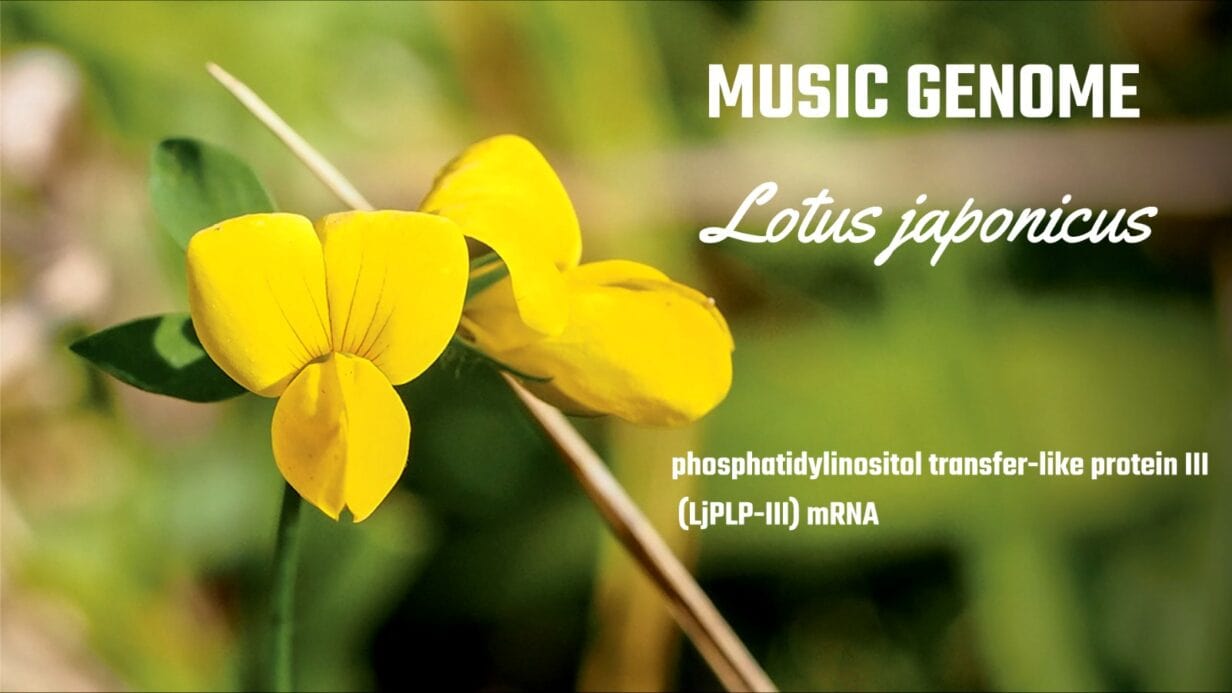
Genome Music: Translating DNA Sequences into Sound Using the PLP-III Gene of Lotus japonicus
Introduction
The idea of converting genetic information into musical structures represents a fascinating fusion of science and art. The genetic code fundamental to all biological life can be “sonified” by transforming nucleotide or amino acid sequences into notes, chords, and rhythmic patterns. This approach opens new ways to visualize complex molecular data and literally hear the structure of a gene.
In this project, a specific fragment of the Lotus japonicus genome responsible for synthesizing the phosphatidylinositol transfer-like protein III (PLP-III) was translated into a musical composition. Below is an overview of what data was used and how it connects to plant molecular biology.
What Exactly Was Converted into Music
The core of the musical composition is the amino acid sequence of the PLP-III protein encoded by Lotus japonicus.
Source Data
- Organism: Lotus japonicus (Japanese lotus)
- Gene: PLP-III
- Gene product: Phosphatidylinositol transfer-like protein III
- Data type: mRNA sequence used to derive the amino acid sequence
- Reference sequence:
NCBI entry AF367433.1
The official reference mRNA fragment was taken from NCBI. This molecule is read by the ribosome during translation and defines the resulting chain of amino acids forming the protein.
In the final composition, you are listening to a melody generated directly from the amino acid sequence of the PLP-III protein.
What the PLP-III Gene Represents
The PLP-III gene encodes a protein belonging to the family of phosphatidylinositol transfer-like proteins. These proteins are essential for:
- transporting lipid molecules within the cell,
- maintaining membrane structure,
- shuttling signaling lipids between organelles.
In plants of the Fabaceae family, including Lotus japonicus, these proteins play an important role in growth, adaptation, and overall cellular function.
How DNA and Protein Sequences Are Translated into Music
The process of converting a gene into music includes several stages.
1. Obtaining the Biological Sequence
The mRNA sequence of the PLP-III gene is extracted from the NCBI database.
2. Translating mRNA → Amino Acid Sequence
Every triplet of nucleotides (a codon) corresponds to a specific amino acid.
This produces a sequence composed of 20 standard amino acids.
3. Assigning Musical Values
Each amino acid is mapped to musical elements, such as:
- specific notes,
- intervals,
- timbre variations,
- rhythmic units.
For example:
- Hydrophobic amino acids may correspond to lower notes,
- Charged amino acids to higher notes,
- Aromatic amino acids to chords or harmonic clusters.
In this way, the biological structure becomes a musical structure.
4. Building the Composition
The resulting melody reflects:
- repeating codon patterns,
- changes in protein structure,
- amino acid diversity,
- overall sequence dynamics.
The outcome is a unique musical “signature” of the PLP-III gene.
Why the PLP-III Gene Was Chosen
This gene is particularly suitable for musical translation because:
- it encodes a protein with a rich and complex structure,
- the amino acid sequence is diverse enough for expressive musical interpretation,
- Lotus japonicus is a well-studied model plant with reliable genetic data,
- the PLP protein family is biologically significant and functionally important.
These features make the resulting musical piece vivid, rhythmically varied, and scientifically meaningful.
Conclusion
The “Genome Music – Adaris Project” demonstrates how bioinformatics can seamlessly merge with art. Using the PLP-III gene of Lotus japonicus, we can listen not just to abstract sound but to a musical interpretation based on real biological data.
This is more than an aesthetic experiment: it offers a new way to perceive molecular structures, explore biological patterns, and experience the dynamics of genetic information through sound.