
PCR Amplification of a Synthetic DNA Fragment Using MBER Spectra: A Quantum Genetic Experiment
Abstract
This paper describes a multi-step experimental protocol in which a synthetic DNA fragment of 547 base pairs was first amplified by standard PCR, then scanned by a helium-neon laser to produce modulated broadband electromagnetic radiation (MBER) carrying the quantum wave information of the DNA. Water samples exposed to this MBER radiation were subsequently used as the sole template in PCR reactions — replacing physical DNA entirely. The resulting PCR products were sequenced and found to be 99.2–100% identical to the original DNA sequence. The experiment also explores an acoustic version of this protocol, in which the MBER signal is converted to sound and used to imprint genetic information onto water without a laser.
Keywords: wave genetics, MBER, PCR amplification, phantom DNA, quantum biocomputer, linguistic-wave genetics, Gariaev, DNA information transfer, torsion information, water memory.
1. Introduction
The central hypothesis of linguistic-wave genetics, developed by P.P. Gariaev and colleagues, holds that DNA carries its genetic information not only in the chemical sequence of its nucleotide bases, but also in a wave form — as polarization-modulated photonic and electromagnetic radiation that can be read, transmitted, and used to direct biological processes without any direct physical contact with the original DNA molecule.
One of the most striking experimental tests of this hypothesis is the question of whether the wave information of a DNA molecule, imprinted onto water by laser-generated MBER radiation, can serve as a functional template for DNA synthesis in a polymerase chain reaction. If such an experiment succeeds — and the product is sequenced and confirmed to match the original — it would constitute direct evidence that DNA information exists and is functionally active in a non-material, wave form.
The experiment described here was designed to test precisely this question.
2. Experimental Protocol
Step 1: Preparation of the Initial DNA Product
The starting material for the experiment was a PCR-amplified DNA fragment of 547 base pairs, produced using a synthetic DNA sequence cloned into a plasmid vector.
Zero-chain DNA sequence (5′→3′):
CCTTACGTCAGTGGAGATGTCACATCAATCAACTTGCTTTGAAGACGTGGTTGGAA
CGTCTTCTTTTTCCACGATGCTCCTCGTGGGTGGGGGTCCATCTTTGGGACCACTG
TCGGCAGAGGCATCTTGAATGATAGCCTTTCCTTTATCGCAATGATGGCATTTGTA
GGAGCCACCTTCCTTTTCTACTGTCCTTGCGCGCTATATTTTGTTTTCTATCGCGT
ATTAAATGTATAATTGGGGGACTCTAATCATAAAACCCATCTCATAAATAACGTCAT
GCATTACATGTTAATTATTACATGCTTAACGTAATTCAACAGAAATTATATGATAAT
CATCGCAAGACCGGCAACAGGATTCAATCTTAAGAAACTTTATTGCACGCATTAAT
GGACTGGATTGGGGCCAACTCCTACCGTACCTGGCATTACCCTTACGCTGAAGAGA
TGCTCGACTGGGCAGATGAACATGGCATCGTGGTGATTGATGAAACTGCTGCTGTC
GGCTTTAACCTCTCTTTAGGCATTGGTTTGGAAGCGGGCA
PCR primers used:
- Forward: 5′-CCTTACGTCAGTGGAGATGTCACATC-3′
- Reverse: 5′-TGCCCGCTTCCAAACCAATGCCTAAAGA-3′
PCR reaction composition (final volume 25 µl per reaction):
- 67 mM Tris-HCl, pH 8.6 at 25°C
- 2.5 mM magnesium chloride
- 16.6 mM ammonium sulfate
- Mixed dNTPs at a total concentration of 300 µM
- Mixed primers, 0.5 µM each
- 2.5 units Taq DNA polymerase
- Plasmid DNA template: 25 ng
PCR temperature program:
- Initial denaturation: 94°C — 3 min.
- 30 cycles: 94°C — 30 s; 62°C — 30 s; 72°C — 40 s
- Final synthesis: 72°C — 5 min.
The PCR product was purified from primers and reaction components using a SiO₂ magnetic particle purification kit (“Silex”, Russia) according to the manufacturer’s instructions. Ten µl of magnetic particles with a binding capacity of 10 µg DNA were used; elution was performed in a total volume of 50 µl of elution buffer.
Step 2: Generation of the MBER Spectrum from the DNA Product
A droplet (25 µl) of the purified aqueous PCR product solution was placed on a clean glass microscope slide and exposed to the beam of a frequency-stabilized helium-neon laser for a minimum of 3 minutes.
As the laser beam passed through the DNA preparation, it was modulated by the wave structure of the DNA — producing secondary modulated broadband electromagnetic radiation (MBER). This MBER was detected by a transistor radio receiver tuned to 700 kHz and converted into an audio wave file format.
At a distance of 15–20 cm from the laser beam, a rack of test tubes was positioned. Each test tube contained purified distilled water, confirmed free of DNA, RNA, and nucleases. The water had been pre-frozen at −20°C and thawed at room temperature (melt water) prior to use — a preparation that enhances the water’s capacity to receive and retain wave information.
During laser scanning, the exposed water samples received the MBER radiation carrying the wave information of the DNA product.
Step 3: PCR Amplification Using MBER-Treated Water as Template
Following laser exposure, the MBER-treated water samples were used directly as the sole template material in standard PCR reactions (25 µl final volume), without the addition of any physical DNA.
All PCR reactions were performed under fully sterile conditions in a UV-irradiated workspace to exclude the possibility of contamination.
PCR reaction composition (identical to Step 1, except no DNA template):
- 67 mM Tris-HCl, pH 8.6 at 25°C
- 2.5 mM magnesium chloride
- 16.6 mM ammonium sulfate
- Mixed dNTPs at a total concentration of 300 µM
- Mixed primers, 0.5 µM each
- 2.5 units Taq DNA polymerase
- Template: MBER-treated water only
Two temperature programs were tested:
Standard program:
- Initial denaturation: 94°C — 3 min.
- 40 cycles: 94°C — 30 s; 62°C — 30 s; 72°C — 40 s
- Final synthesis: 72°C — 5 min.
Extended elongation program:
- Initial denaturation: 94°C — 3 min.
- 40 cycles: 94°C — 30 s; 62°C — 30 s; 72°C — 2–7 min.
- Final synthesis: 72°C — 5–7 min.
Both programs produced PCR products of the expected length. The highest yield of target product was consistently obtained using the 7-minute elongation time in each of the 40 cycles, suggesting that the wave-imprinted template information requires more time for the polymerase to process than a conventional physical DNA template.
Step 4: Analysis of PCR Results
After PCR completion, all samples were mixed with gel loading buffer containing the fluorescent dye SYBR Green I (“Silex”, Russia) and analyzed by electrophoresis in 1.5% agarose gel using standard protocols in TBE buffer. Results were visualized on a UV transilluminator at 365 nm wavelength.
Samples were scored as positive when their bands migrated to the same position as the positive control band, corresponding to a DNA fragment of 547 bp.
Positive control: standard PCR reaction with 25 ng plasmid DNA template, 30 cycles.
Fragment size marker: 139, 268, 450, 613 bp.
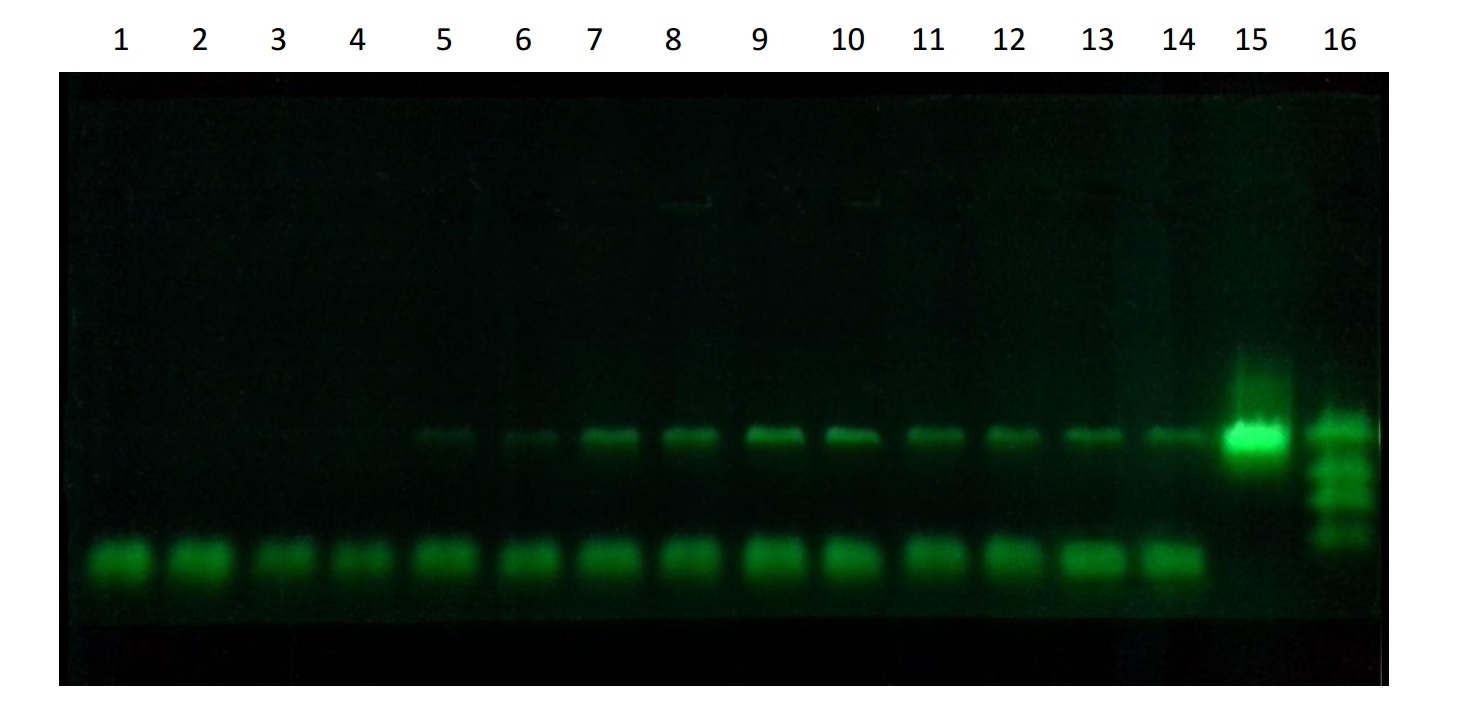
[IMAGE 1 — Agarose gel electrophoresis results: lanes 1–14 show PCR products from MBER-treated water samples (no physical DNA template); lane 15 shows positive control (plasmid DNA template, 25 ng); lane 16 shows molecular weight marker (139, 268, 450, 613 bp). Bands in positive experimental lanes migrate to the same position as the 547 bp positive control band.]
Sequencing results: Experimental PCR products were subjected to Sanger sequencing, alongside the positive control and the original DNA product used for laser scanning. Sequencing confirmed that the experimental products were 99.2–100% identical to the original synthetic DNA sequence from which the MBER information had been read.
3. Acoustic Version: Sound as a Carrier of DNA Wave Information
A further development of this experimental approach involves converting the MBER signal into an acoustic (sound) format and using this audio recording — rather than direct laser exposure — to imprint DNA information onto water.
In this protocol, the MBER audio file recorded during Step 2 was played through a loudspeaker positioned beneath test tubes containing the same purified, pre-frozen and thawed melt water. Exposure duration was 30 minutes prior to PCR setup.
Results: Of 14 water samples treated with acoustic MBER (tubes 1–14):
- The first 4 samples did not yield a PCR product — a result tentatively attributed to fluctuations in MBER output not yet fully characterized
- The remaining positive samples produced PCR products confirmed by sequencing to be up to 99% identical to the original plasmid DNA matrix from which the laser readout had been performed
- Background control reactions (using the same water without acoustic MBER treatment) yielded zero product in every case, confirming the complete absence of DNA contamination in the system
This acoustic-torsion version of quantum DNA information transfer represents a significant practical simplification of the experimental protocol. If the acoustic signal retains the torsion-information component of the MBER radiation — as hypothesized — then laser equipment is not required for the delivery stage, and the genetic information can be transmitted and stored in a standard audio file format.
This development can be understood as an extension of the ideas of Nobel Prize laureate Luc Montagnier, who demonstrated that DNA sequences could produce electromagnetic signals in water and that these signals could direct the synthesis of DNA in a recipient water sample — a phenomenon closely parallel to what is described here.
4. Discussion
4.1 Interpretation in the Framework of Wave Genetics
These results are fully consistent with the theoretical framework of linguistic-wave genetics. The genome, in Gariaev’s model, stores and transmits biological information in two parallel modes: the chemical mode (nucleotide sequences) and the wave mode (polarization-modulated photonic and electromagnetic fields). The MBER generated by laser scanning of DNA represents the wave-mode information of the molecule — information that, when imprinted onto water, is sufficient to direct the synthesis of a specific DNA sequence by Taq polymerase using only the standard nucleotide building blocks.
The 99.2–100% sequence identity between the experimentally synthesized products and the original DNA confirms that the wave information carried by MBER is not merely a non-specific activating stimulus, but a specific, accurate, sequence-encoding signal — a true quantum equivalent of the physical DNA molecule.
4.2 The Role of Melt Water
The use of pre-frozen and thawed melt water as the recipient medium is significant. The structured hydrogen-bond network of water — and particularly the altered structure produced by freeze-thaw cycling — is known to enhance the capacity of water to retain and express wave information. This is consistent with the broader body of research on water memory and the sensitivity of water’s physical microstructure to weak electromagnetic and torsion influences.
4.3 The Extended Elongation Time
The observation that a 7-minute elongation phase produces the highest yield of PCR product from wave-imprinted water — compared to the 40-second elongation used with physical DNA template — is noteworthy. It suggests that the wave template imprint in water presents a less direct or less stable reading surface for Taq polymerase than a conventional DNA molecule, requiring more time for each synthesis cycle. This observation may provide a handle for further mechanistic investigation of the interaction between polymerase and wave-form genetic information.
5. Conclusion
This experiment provides direct experimental evidence for the existence of a wave form of DNA information that is:
- Readable by a frequency-stabilized helium-neon laser from a physical DNA preparation
- Transmissible to water through MBER radiation at distances of 15–20 cm
- Convertible into an acoustic format that retains functional biological activity
- Capable of directing sequence-specific DNA synthesis in a standard PCR system without any physical DNA template
- Accurate to 99.2–100% sequence identity with the original DNA, as confirmed by sequencing
These findings support the concept of phantom DNA — a wave structure that retains and can express the genetic information of a physical DNA molecule after the molecule itself is removed — and provide a foundation for the practical application of wave-genetic information transfer in medicine, biotechnology, and materials science.
The equipment used in this research — a polarization laser spectrometer for wave genetics experiments — is available for independent replication of these results.
References
- Prangishvili I.V., Gariaev P.P., Tertyshny G.G., Maksimenko V.V., Mologin A.V., Leonova E.A., Muldashev E.R. Spectroscopy of Radio-Wave Radiations of Localized Photons: Access to Quantum and Non-Local Bioinformation Processes. Sensors and Systems. 2000, No. 9 (18), pp. 2–13.
- Gariaev P.P. Another Understanding of the Model of Genetic Code. Open Journal of Genetics. 2015, v.5, pp. 92–109.
- Gariaev P.P., Vladychenskaya I.P. PCR Amplification of Phantom DNA Recorded as Potential Quantum Equivalent of Material DNA. DNA Decipher Journal. March 2016, v.6, issue 1, pp. 1–11.
- Montagnier L. et al. Electromagnetic Signals Are Produced by Aqueous Nanostructures Derived from Bacterial DNA Sequences. Interdisciplinary Sciences: Computational Life Sciences. 2009, v.1, pp. 81–90.
- Tertyshny G.G., Garyaev P.P. Wave Genetic Nanotechnologies for the Control of Biological Systems: Theory and Experiments. New Medical Technologies. 2007, No. 7, pp. 49–64.