
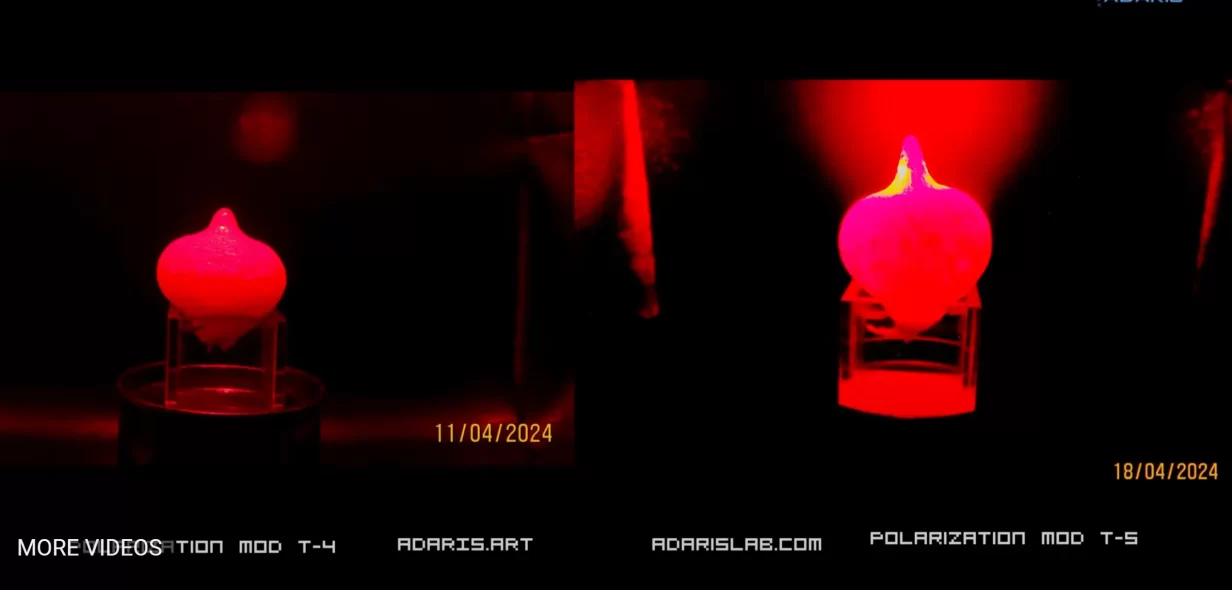
Quantum Biology Experiment: The Holographic Method of Biosystem Control
Modern quantum biology opens entirely new horizons for science and medicine.
One of the most intriguing directions is the holographic method of biosystem control, based on the use of coherent laser radiation with right and left circular polarization.
These experiments connect physics, chemistry, and genetics into one coherent system of interaction.
The Concept and Background
The article by K. V. Tyuts, “Laser–Holographic Method of Biosystems Control,” describes that it is possible to influence the genetic and metabolic activity of living organisms using laser radiation of specific circular polarization.
A Helium–Neon laser (He–Ne) with a wavelength of 632.8 nm (~474 THz) was used, capable of generating both right- and left-handed circular polarization.
Researchers I. S. Filimonenko and G. G. Tertyshny, formerly associated with P. P. Garyaev’s wave genetics group, further developed this concept, linking it to the theory of torsion fields and informational electromagnetic interactions.
It was proposed that such coherent radiation carries not only electromagnetic energy but also an information-bearing wave signal capable of influencing living cells.
Practical Experiment: Influence on Plants
A simple but revealing experiment was carried out on plants.
Two identical groups of sprouts were exposed to laser light of equal power, with identical soil, water, and environmental conditions. The only difference was the polarization of the laser beam — right-handed in one group, left-handed in the other.
The difference in growth, leaf structure, and color intensity was clearly visible.
The experiment was performed in a fully shielded box, eliminating any external light influence.
These results indicate that the rotation direction of the light’s electromagnetic field directly affects the biochemical and genetic processes occurring in biological systems.
Why Right and Left Circular Polarization Produce Different Effects
To understand this, one must remember that all living molecules are chiral — they exist in two mirror-image forms, just like right and left hands.
DNA, amino acids, and proteins all have this property of chirality. Therefore, light with right or left circular polarization interacts with them differently.
- Right Circular Polarization (RCP) tends to enhance replication and growth processes, stimulating enzyme activity and accelerating cell division.
- Left Circular Polarization (LCP) often produces a stabilizing or regenerative effect, supporting tissue healing and restoration.
This difference arises because the electromagnetic field of circularly polarized light rotates in a spiral, either matching or opposing the natural spiral of DNA.
When the directions coincide, resonant interaction occurs, enhancing biophotonic communication and activating so-called “dormant” genes.
Holographic and Torsion Aspects
Under coherent laser emission, a volumetric electromagnetic structure resembling a hologram is formed.
When this field is circularly polarized, it creates an informational–wave pattern, which, according to A. Akimov’s torsion field theory, may generate torsion fields — subtle spin-based information fields.
Such torsion fields are believed to transmit nonlocal information, potentially allowing wave-based transfer of genetic or metabolic data between biological systems.
This principle underlies the classic experiments by G. G. Tertyshny, who demonstrated wave-mediated information transfer between bacterial cultures.
Biophotonic and Quantum-Level Effects
From a modern photobiological viewpoint, circularly polarized light can influence living matter on multiple levels:
- DNA and Proteins – Circular polarization may alter molecular conformation, activating or suppressing specific genetic sequences.
- Cellular Receptors – Certain membrane proteins are sensitive to light polarization, initiating specific signaling cascades that regulate growth or differentiation.
- Tissue Regeneration – Studies indicate that right-handed polarization accelerates cell proliferation, while left-handed polarization supports differentiation and structural repair.
- Photodynamic Therapy – In oncology, polarization-sensitive light is used to activate photosensitizers that selectively destroy cancer cells.
Thus, circular polarization serves as a precise biophysical instrument, influencing not chemical reactions but the informational architecture of living systems.
Future Prospects and Applications
The development of next-generation laser systems makes it possible not only to perform research but also to create personalized wave-based programs — from meditative “DNA music” compositions to bioinformational resonance protocols.
Such technologies open the path toward quantum-biological healing, regeneration, and optimization of physiological processes through light-based information fields.
Conclusion
The distinct effects of right and left circular laser polarization are far more than a physical curiosity — they represent a new paradigm in the interaction between light and life.
In this model, the wave nature of matter and the informational dynamics of biology merge into a unified system.
The future of quantum biology may well depend on these holographic methods of biosystem control, where light becomes both the messenger and the architect of life itself.