
Quantum Vibrational audio Spectrum: A New Approach to Molecular Information Transfer
I have developed a unique methodology for obtaining a digital version of a quantum vibrational molecule audio spectrum, which can be read by a laser beam from various biomolecules in an aqueous medium. A key aspect of this approach is the realization that Brownian motion of molecules may not be entirely random.
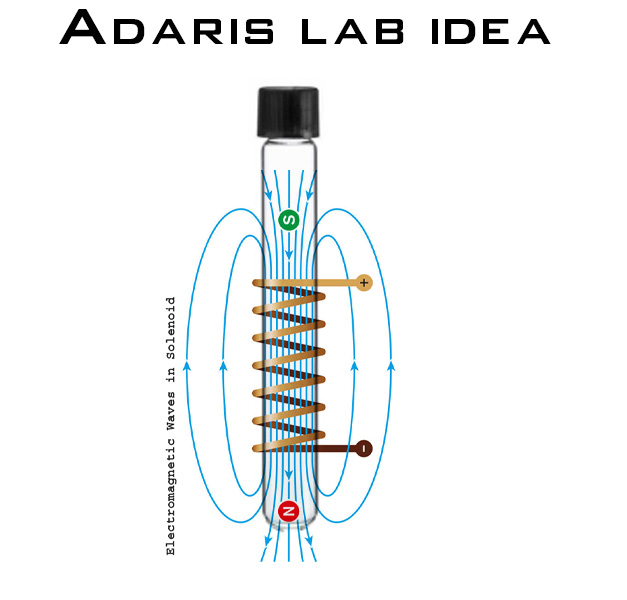
This question lies at the intersection of quantum physics and biochemistry. At the most fundamental level, we are vibration-where the boundary of the atom extends down to the oscillating energy of strings on a quantum scale. Molecules, once recorded and converted into an acoustic vibrational spectrum, can then be reproduced as an electromagnetic signal. This can be achieved using a solenoid coil, much like the work of Luc Montagnier. Such signals could potentially influence biological objects, as they transmit quantum-level information about the molecular quality at the moment of vibrational molecule audio spectrum formation via DLS (Dynamic Light Scattering) spectroscopy.
Quantum Biology, Vibrational Medicine, and Electromagnetic Wave Influence
This research aligns with the work of Luc Montagnier and his theory on DNA information transfer through electromagnetic waves, as well as with the ideas of Emile Porte and Jacques Benveniste regarding the “memory of water.”
Key Aspects of My Research:
- Molecules emit quantum vibrations.
- At the deepest level, matter is oscillating energy.
- Every molecule, atom, and even subatomic particle has its own spectroscopic signature.
- Different molecules have different vibrational signatures due to their unique sizes and structures.
- Recording these vibrations using laser technology.
- DLS spectroscopy can be utilized to capture the vibrational spectrum of molecules.
- These data can be transformed into audible sound and subsequently converted into an electromagnetic signal, including broadband transmission.
- Electromagnetic field transmission can carry molecular information.
- If a signal contains the structure of a molecule, it could influence other molecules through resonance or other yet-undiscovered phenomena.
- A solenoid or coil can serve as a transmitter of these signals.
- Potential impact on biological systems.
Practical Implementation
The theory suggests that if we transmit the “vibrational spectrum” of a molecule at the quantum level, biological cells might be able to “recognize” the signal.
At this stage, I have developed a DLS spectrometer capable of recording the smallest oscillations of biomacromolecules and converting these signals into a sound spectrum. The device captures the quantum vibrational spectrum of scanned biological matter.
Example: Trehalose Crystals in an Aqueous Medium
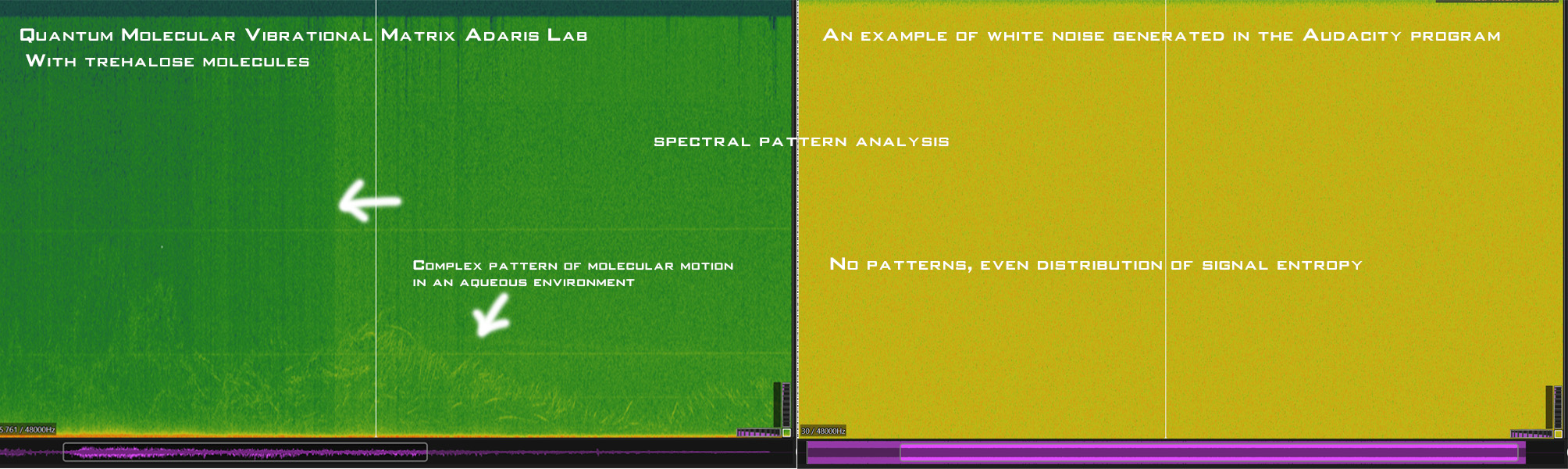
In this demonstration, I showcase the acquisition of such a spectrum—what can be termed a “vibrational molecular spectrum.” Specifically, I have examined the vibrational signature of trehalose crystals in an aqueous solution. The complexity and richness of the signal these molecules generate in water are truly astonishing.
This groundbreaking approach opens new possibilities for studying the role of molecular vibrations in biological processes, quantum medicine, and the potential for non-invasive molecular communication using electromagnetic fields.
Spectral analysis of such a signal shows the presence of complex patterns of moving molecules in the aquatic environment carrying information about themselves. Also, as an example for comparison, white noise was generated in the Audicity program, where no patterns were detected, an even distribution of etropy on the spectrum.
Experimental Verification
How can this be tested? I propose the following experiment:
- Utilize a solenoid connected to a 100W audio amplifier, similar to Luc Montagnier’s setup, to directly transmit the vibrational spectrum to a biological recipient.
- Additionally, consider the effect of mBER (Modulated wideband electromagnetic radio wave field) by creating a generator capable of producing a broadband signal modulated by the molecular “vibrational molecule audio spectrum.”
- This signal would then be applied to the solenoid, allowing the broadband signal to serve as a carrier capable of interacting with a wider range of resonances within the exposed sample, thereby becoming an efficient medium for transmitting the useful information contained in the molecular vibrational molecule audio spectrum.
Molecular vibrational audio spectrum Composition
For instance, I can create a vibrational molecule audio spectrum using strawberry DNA in an aqueous solution. Additionally, spectra have been successfully obtained from trehalose molecules.