
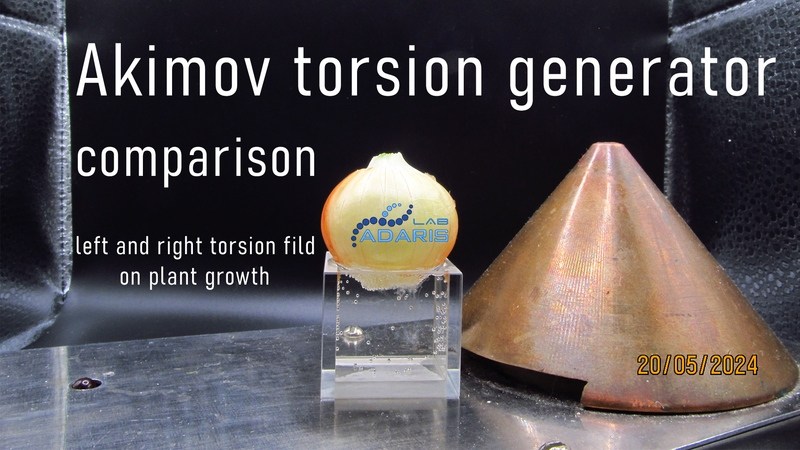
Comparative Experiment on the Influence of Left and Right Torsion Fields of the Akimov Generator on Plant Growth
Introduction
Torsion fields and their effects on living organisms have remained a topic of interest in alternative physics and biophysics for several decades. Despite skepticism from mainstream science, a number of laboratories continue to study subtle physical interactions between torsion fields and biological systems.
In the Adaris Laboratory, an experiment was conducted using the Akimov torsion field generator to identify the differences between the influence of left and right torsion fields on plant growth.
Experimental Description
As a biological recipient, onion bulbs (Allium cepa) were selected because they respond quickly to environmental changes and are widely used as bioindicators.
The experiment lasted 12 days and consisted of two stages:
- During the first 6 days, the onions were exposed to the left torsion field.
- During the next 6 days, they were exposed to the right torsion field.
The Akimov torsion generator was modulated at a frequency of 777 Hz and powered by a 15V DC source. The generator operated continuously throughout the entire experiment, maintaining a stable torsion field around the growth zone of the plants.
Methodology and Experimental Conditions
All onion bulbs were selected from the same batch and had approximately the same size and weight. Before the start of the experiment, each bulb was placed in a separate plastic container with water to ensure contact of the basal part with moisture, which stimulates root development.
Controlled environmental parameters:
- Air temperature: 22–24 °C
- Lighting: diffused natural daylight
- Humidity: approximately 60%
- No fertilizers or chemical stimulants were used
The only variable between the two groups was the direction of the torsion field — left or right.
Results and Observations
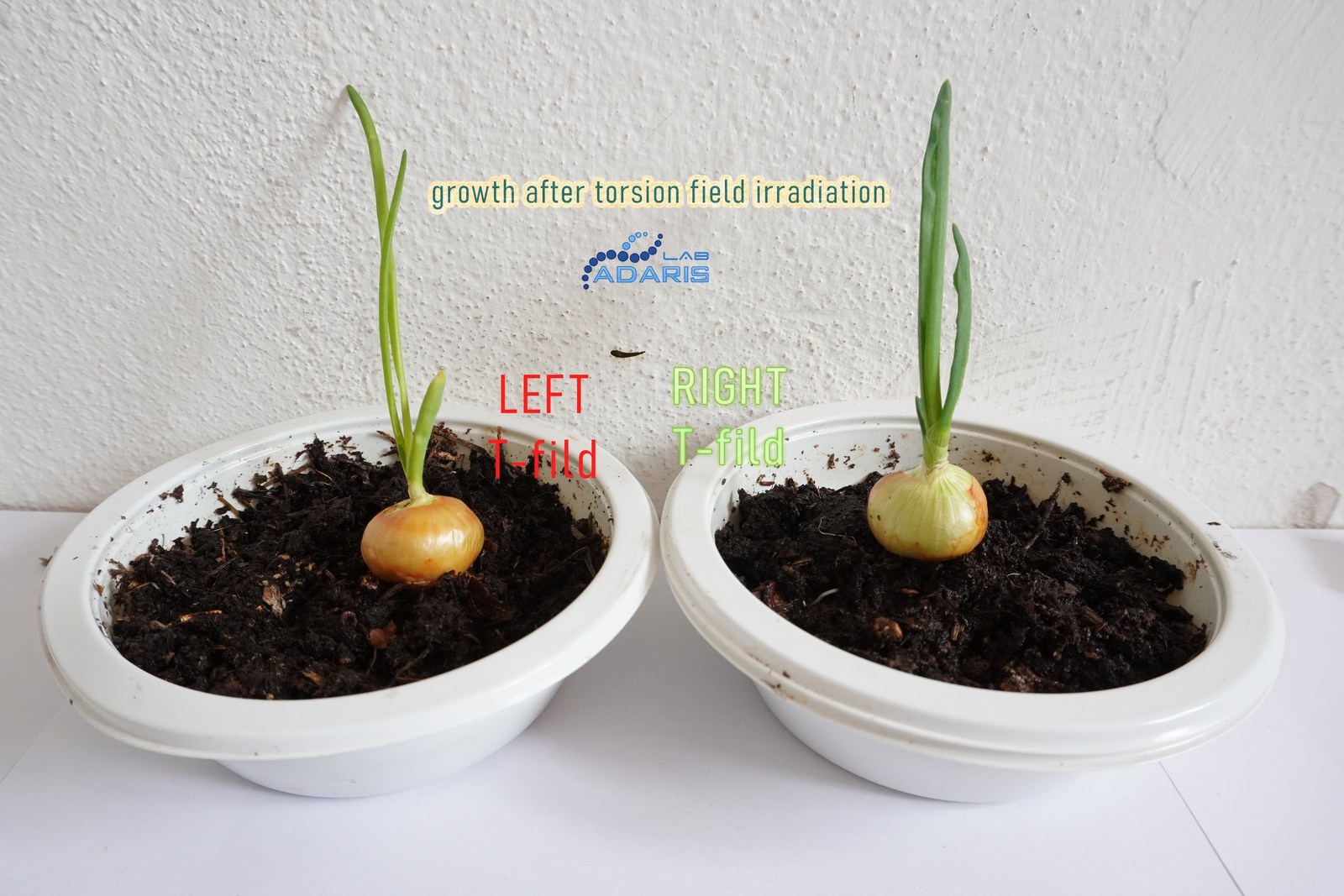
After 6 days of exposure to the left torsion field, the onions showed rapid growth — the roots elongated quickly, and the leaves grew upwards. However, upon closer inspection, it was observed that the plants’ structure was fragile: the roots were thin and weak, and the leaves were soft with reduced elasticity.
When the generator mode was switched to the right torsion field for the next 6 days, the growth rate decreased, but the overall structure of the plants became stronger and more stable. The roots appeared thicker, and the leaves were firmer and more resilient. The plants demonstrated a more balanced and harmonized morphology compared to those under the left torsion field.
Analysis and Discussion
These observations suggest that left and right torsion fields may influence biological growth processes in different ways. The left torsion field likely stimulates metabolic activity and accelerates cell division, but it may also reduce the structural integrity of plant tissues. The right torsion field, on the other hand, appears to stabilize cellular structures and enhance internal coherence, resulting in slower growth but stronger and more resilient plants.
This difference could be explained by the hypothesis that the left torsion field promotes dispersion of the biofield, while the right torsion field promotes its harmonization and structural alignment. Similar patterns have been mentioned in some studies dealing with biophysical aspects of torsion field interactions with living organisms.
Conclusion
The experiment with the Akimov torsion generator demonstrated that the direction of the torsion field has a significant impact on plant growth characteristics.
- The left torsion field accelerates growth but produces weaker and less stable tissues.
- The right torsion field slows down growth but leads to stronger and more harmonious plant structures.
These findings open possibilities for further research in the field of torsion biophysics and may have potential applications in developing non-chemical methods for optimizing plant growth and improving resistance to environmental stress factors.