
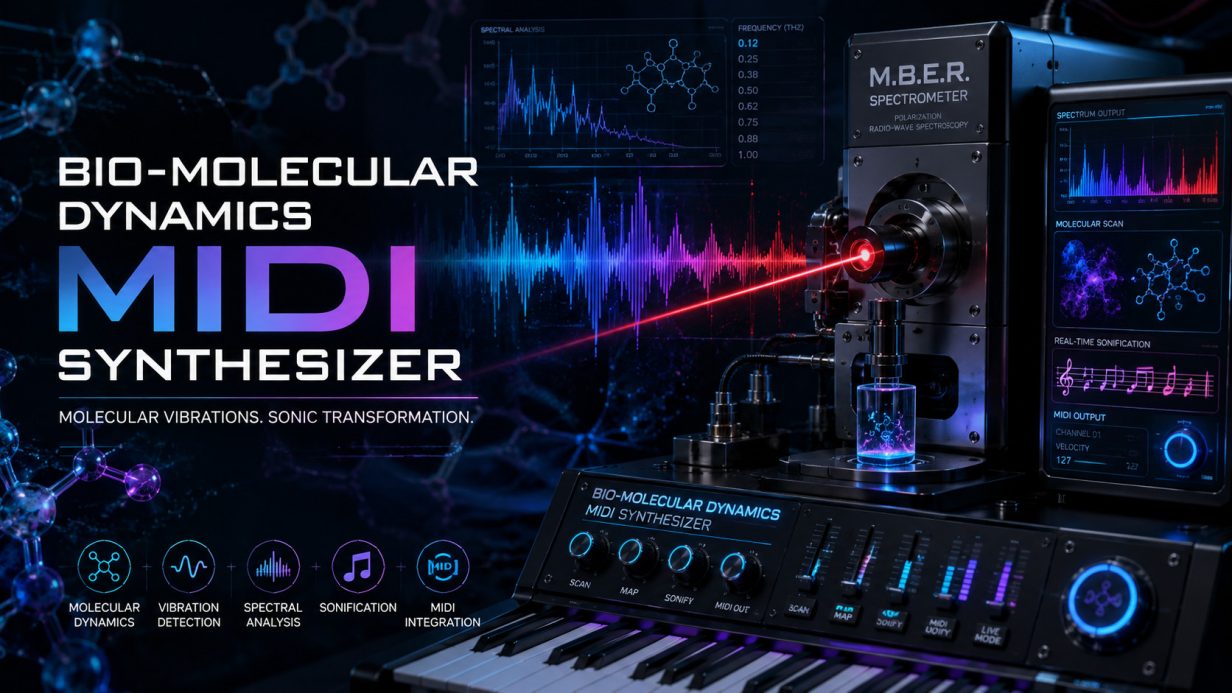
Bio-Molecular Dynamics MIDI Synthesizer adaris lab
An experimental instrument that turns the interaction of laser light with a molecular sample into live, playable MIDI — where physics becomes performance.
Most synthesizers begin with an oscillator. This one begins with a laser beam and a drop of matter. The Bio-Molecular Dynamics MIDI Synthesizer is a hardware system developed at the Adaris Laboratory. A laser interacts with a substance held in an optical cell, and a proprietary core inside the instrument translates that interaction into musical events in real time.
The result is an instrument with no factory presets and no fixed sound. What you hear depends entirely on the sample scanning in the optical cell — a different liquid, a different molecule, produces a different musical signature.
What the device is
At its core, the synthesizer is a compact optical instrument driven by an microcontroller. A laser is directed through a transparent cuvette holding the sample, and the microcontroller processes and registers the resulting data, then outputs it as MIDI. Technology based on spectroscopy MBER.
Everything happens on the device. There is no PC required to generate the data — the board behaves like a self-contained instrument that simply speaks the language every studio already understands: MIDI.
How it works
Reading the molecular signal
When the laser interacts with the sample, the molecules in solution disturb the light in subtle, constantly shifting ways. Vibrations of molecules, density variations, and the polarization properties of the substance all leave their mark. The instrument treats this as its source material — a living signal that carries the “personality” of whatever is in the cuvette.
Nothing here is sampled or pre-recorded. Hidden inside every molecule is a vibration too subtle to perceive — and the instrument coaxes it into the open, folding that secret motion into a living MIDI map. The molecules writes its own score; the device only gives it a voice.
Plug it in like any MIDI keyboard
This is where the project becomes genuinely usable rather than just a curiosity. You simply connect the laser system as a USB MIDI keyboard device, and it can be recognized by most music production software. There are no proprietary drivers and no special bridge application to install — the microcontroller enumerates as a standard class-compliant USB MIDI device.
The instrument instantly becomes part of your digital studio environment, allowing molecular spectral data to be transformed into live musical performance. Open your DAW, select the device as a MIDI input, and arm a track. Every note, velocity value, and modulation curve generated from the molecular signal flows straight into your session.
Inside the studio
Since the output is just standard MIDI, the sound design is entirely up to you. During testing, the stream was routed into FL Studio to drive a VST, but the device itself is instrument-agnostic. That said, its internal logic and note mapping were designed with these musical styles in mind — so it’s especially at home with soft pads and ambient textures.
Technical overview
| Concept | Laser interaction with a molecular sample, translated to MIDI |
| Processing | microcontroller |
| Output | Class-compliant USB MIDI (notes, velocity, CC) |
| Compatibility | Any DAW or VST host that accepts USB MIDI input |
| Tested with | FL Studio + VST |
| Latency | Real-time — playable as a live performance instrument |
Why it matters
The Bio-Molecular Dynamics MIDI Synthesizer sits at the meeting point of laser optics, embedded engineering, and electronic music. It reframes physics as a creative tool, and gives composers a true generative source — one rooted in a real physical process. Each performance is, in a literal sense, unrepeatable: change the substance, and you change the music.
See it in action
The video below is a full presentation of the system — the optical setup, the live MIDI stream, and the sound it produces inside the studio.
How difficult is it to set up this laser setup? The difficulty level is difficult. Precise micron-level adjustment of the laser setup’s external optics is required. Otherwise, the laser setup won’t work!
This laser setup is still an experimental laboratory device.
Bio-Molecular Dynamics MIDI Synthesizer — an experimental instrument developed at the Adaris Laboratory. The internal sensing and signal method is proprietary. The system is intended as an artistic/experimental instrument rather than an analytical measurement device.