
Laser Holographic Transfer of Biological Information: Experiments in Remote Control of Cellular Functions
Authors: G.G. Tertyshny, Yu.I. Ostrovsky, V.L. Eventov, M.Yu. Andrianova
Institute of Control Sciences, Russian Academy of Sciences (Trapeznikov Institute); Russian Scientific Center for Surgery named after Academician B.V. Petrovsky, RAMS
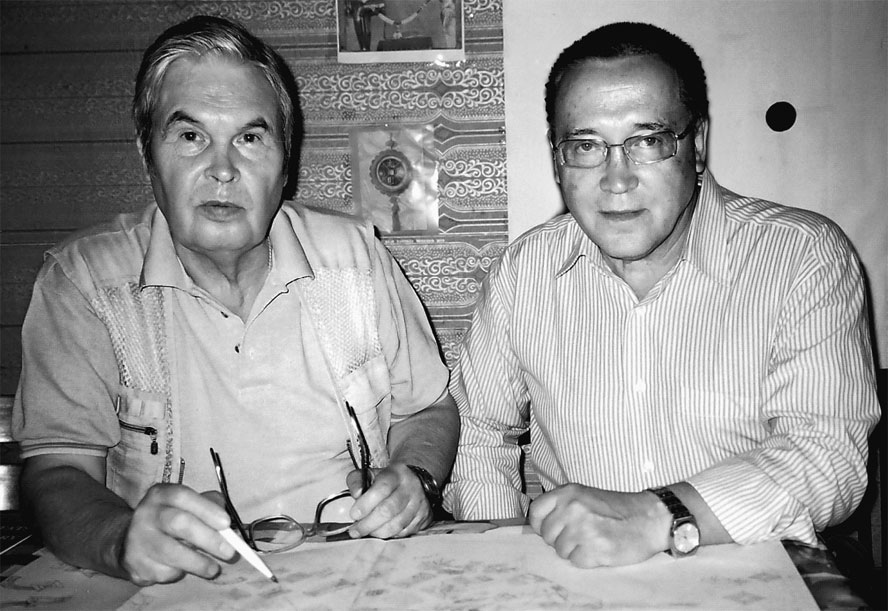
Read more about the work of researchers Georgy Tertyshny, a physicist from the Group of Peter Garyaev. Photo source WEBARCHIVE.
Abstract
This article presents results of experiments on treating diabetes mellitus in rats by irradiating them with radio waves modulated by the electromagnetic radiation of biological structures using a laser. Two known sources of electromagnetic radiation of biostructures are examined: high-frequency mitogenetic radiation and low-frequency radiation caused by changes in the permeability of cell membranes. It is demonstrated that mitogenetic radiation cannot account for the observed therapeutic effect. Hypotheses are proposed regarding the radiation source responsible for the therapeutic effect and the mechanism of radio wave modulation by biostructure radiation.
Keywords: diabetes mellitus treatment, mitogenetic radiation, cell membrane permeability, radio wave modulation, laser, holographic control.
1. Introduction
This work investigates the possibility of controlling the functional state of cells through the remote transfer of biological information using laser radiation and modulated radio waves.
The experiments described below cover three main directions:
- Treatment of alloxan-induced diabetes mellitus in rats
- Transfer of antibiotic sensitivity between bacterial strains
- Holographic control of biosystems
The research was conducted at the Trapeznikov Institute of Control Sciences of the Russian Academy of Sciences and at the Russian Scientific Center for Surgery named after Academician B.V. Petrovsky.
2. Non-Invasive Transfer of the Frequency-Amplitude Composition of the Electromagnetic Field of Bacteria for Correction of Their Functioning
2.1 Introduction
Bacteria, in addition to their material cellular structure, possess an individual field structure. This structure forms and determines the cycle of bacterial functioning. Under exogenous field influence, changes in bacterial functioning are possible. For effective impact on a specific bacterial species, the electromagnetic field of external influence must be analogous in the majority of parameters to the internal field of those bacteria.
Research objective: Using a laser scanner, to assess the transfer of sensitivity to vancomycin from the vancomycin-sensitive strain Enterococcus hirae (ATCC 10541) to the vancomycin-resistant strain Enterococcus hirae (ATCC 51575), and to confirm that the observed changes in the resistant strain require the presence of a donor in the laser apparatus.
2.2 Materials and Methods
A two-mode helium-neon laser scanner LGN-303 was used for reading and transferring the field structure of bacteria. As the laser beam passes through the electromagnetic field of bacteria, it becomes modulated by that field structure — expressed as a change in the frequency-amplitude characteristic of the beam.
- Recipient: Enterococcus hirae ATCC 51575 (vancomycin-resistant strain)
- Donor: Enterococcus hirae ATCC 10541 (vancomycin-sensitive strain)
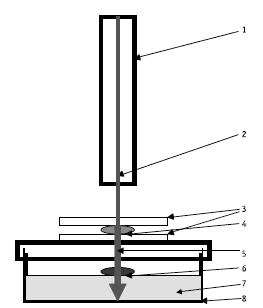
[IMAGE 1 — Diagram of the laser scanner: 1 — laser, 2 — laser beam, 3 — cover glasses, 4 — donor (vancomycin-sensitive strain Enterococcus hirae ATCC 10541), 5 — laser beam modulated by the frequency-amplitude component of the bacterial field, 6 — recipient (vancomycin-resistant strain Enterococcus hirae ATCC 51575), 7 — agar, 8 — Petri dish]
2.3 Preparation of Microorganism Cultures
Both strains were pre-tested to confirm their resistance or sensitivity to vancomycin. Cell cultures were applied in strips to Petri dishes with agar medium, and discs containing vancomycin (5 µg) were placed on the agar surface. The Petri dishes were then placed in a thermostat for 24–48 hours at 30–35 °C.
Results:
- The sensitive strain produced a clear zone of growth suppression (~3.8 mm from the disc)
- The resistant strain produced a turbid zone of growth suppression (~0.8 mm from the disc)
These results confirmed the phenotype of both microorganisms.
2.4 Experimental Protocol
The vancomycin-sensitive strain Enterococcus hirae ATCC 10541 was pelleted by centrifugation at 1500 rpm, the supernatant was removed, and the pellet was placed between two cover glasses to serve as the donor.
The recipient (resistant strain ATCC 51575) was applied to 6 Petri dishes:
- Dishes 1 and 1a — treated with a laser beam that passed through cover glasses containing the donor
- Dishes 2 and 2a — treated with a laser beam that passed through empty cover glasses (no donor)
- Dishes 3 and 3a — control group, isolated in a metal-shielded box in a separate room, no laser exposure
Immediately after the experiment, portions of the processed recipient cell cultures were selected from each Petri dish, placed in bottles with 8 ml of medium (broth), and incubated overnight at 30–35 °C.
2.5 Results
In the control samples (2, 2a, 3 and 3a), the average cell concentration after 4 hours was 9.38 × 10⁸ cells/ml.
In the samples exposed to the modulated laser beam carrying information from the donor (1 and 1a), the average cell concentration was 4.127 × 10⁸ cells/ml.
The difference in cell concentration was 44%, convincingly demonstrating the influence of transferred properties from the sensitive bacterial strain upon the resistant one.
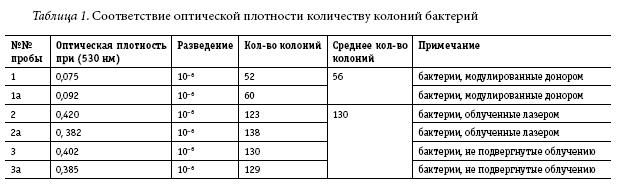
[IMAGE 2 — Table 1: Correspondence of optical density to the number of bacterial colonies (turbidimetric analysis results)]
2.6 Conclusions
- The frequency-amplitude components of the field structure scanned by the LGN-303 laser from vancomycin-sensitive strain Enterococcus hirae ATCC 10541 caused the death of 43% of bacteria of vancomycin-resistant strain Enterococcus hirae ATCC 51575 (p < 0.001).
- Laser irradiation of the resistant strain ATCC 51575 without a donor did not lead to their death — consistent with the control group results.
3. Controlling the Normalization of Cellular Functioning via Radio Waves Modulated with Information About Healthy Young Cells
3.1 Sources of Electromagnetic Radiation of Biostructures
Two sources of electromagnetic radiation from living cells are known:
A) Mitogenetic Radiation
The effect of mitogenetic radiation was described in detail by A.G. Gurvich in experiments with onion roots. Actively dividing cells at the tip of one onion root initiated mitosis in tissue of another, chemically isolated root at a distance of 2–3 mm. The information signal was found to be transmitted by weak radiation in the wavelength range of 1800–2500 Angstroms (ultraviolet spectrum), with weak absorption in quartz and strong absorption in glass.
The source of mitogenetic radiation is the DNA of cell nucleus chromosomes, though it is also observed in certain enzymatic reactions outside living organisms. The intensity of mitogenetic radiation is extremely low — approximately several thousand photons per second per 1 cm² — making physical detection extremely difficult.
A.V. Budagovsky proposed a hypothesis that DNA chromosome radiation constitutes a hologram containing information about the organism as a whole. This hypothesis was confirmed in experiments with plant tyloses: the number of cherry shoot formations in the holographic information transfer group reached 26.1 ± 9.2%, compared to just 3.6 ± 2% in the control group.
B) Low-Frequency Electromagnetic Radiation Caused by Changes in Cell Membrane Permeability
Many living cells function as electrochemical generators. Ion flows moving under the influence of chemical concentration gradients generate a low-frequency electromagnetic field (from fractions of a hertz to 1 kHz) that reflects the functioning of the corresponding organs. The electrical component of this field is widely used in electrophysiological diagnostics — electrocardiography, electroencephalography, etc.
When the stimulating influence exceeds a threshold value, a jump in membrane permeability occurs, generating an action potential — a rapid change in transmembrane potential reaching amplitudes of several tens of millivolts. These oscillatory processes are strictly individual for different organisms and different cell types within a specific organism.
3.2 Which Source Provides the Therapeutic Effect?
Analysis shows that mitogenetic radiation cannot provide the observed therapeutic effect, because:
- High-frequency UV radiation cannot penetrate through the tissues of a living organism to reach the pancreas
- The power of mitogenetic radiation is negligibly small, detectable only by biological detectors and photon counters
By contrast, low-frequency radiation (up to 1000 Hz) modulating radio waves with a carrier frequency in the range of 50 kHz – 2 MHz freely penetrates the tissues of a living organism. Its power is incomparably greater than that of mitogenetic radiation, and its electrical component is effectively registered by standard medical equipment. It is therefore the most likely source of biological information responsible for the therapeutic effect.
3.3 Hypothesis on the Mechanism of Radio Wave Generation and Modulation by the Laser
Under certain conditions, plasma self-oscillations — known as striations — spontaneously arise in a laser tube. It is hypothesized that as the laser beam passes through pancreatic tissue preparations, the striations undergo amplitude modulation by the low-frequency electromagnetic radiation of the β-cells, caused by changes in membrane permeability. The modulated beam is partially reflected back into the laser cavity, and the laser tube acts as a radiating vibrator emitting radio waves at a carrier frequency equal to the striation frequency, modulated with biological information.
Verification of these hypotheses requires dedicated experimental investigation.
4. Experiments on Treatment of Alloxan Diabetes Mellitus in Rats
4.1 Initial Experiments (Institute of Control Sciences, RAS)
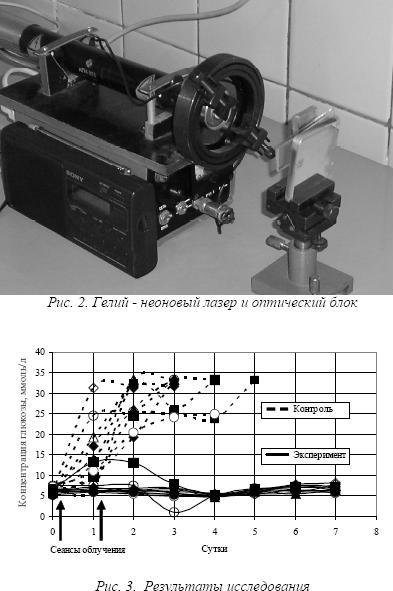
At the Institute of Control Sciences of the Russian Academy of Sciences, G.G. Tertyshny developed a device for direct transfer of mitogenic radiation from living donor cells to recipient cells using a laser beam.
The device consists of:
- A 2 mW helium-neon laser with automatic thermofrequency stabilization of radiation
- An optical block with two semi-transparent mirrors
- A biological donor object placed between the mirrors
Diabetes mellitus was induced by injection of alloxan solution at a concentration of 200 mg/kg of animal body weight. All rats in the control group died on the 4th day after injection, with blood glucose levels exceeding 30 mmol/l.
Rats in the experimental group, beginning from the 2nd day after alloxan injection, were irradiated with modulated broadband electromagnetic radiation (MBER) generated by passing the laser beam through freshly prepared pancreatic and spleen tissue samples from newborn rats.
Result: In 80% of animals in the experimental group, a reliable decrease in blood glucose level was observed and the rats recovered. Only 20% died from severe hyperglycemia on days 6–7.
Histological examination of the pancreas of experimental group rats subjected to euthanasia 1.5 months after alloxan injection revealed activation of regeneration processes in the pancreas. Blood glucose levels in these animals were below 10 mmol/l.
4.2 Experiments at the Russian Scientific Center for Surgery, RAMS
At the RSCS of RAMS, studies were conducted on the effect of radio waves — modulated with information about normally functioning pancreatic cells of 10–14-day-old infant rats — upon adult rats with diabetes mellitus.
Experimental protocol:
Ten male WISTAR-population rats (weight 285–310 g) received intraperitoneal injections of alloxan solution at 200 mg/kg body weight. Three hours after injection, irradiation was begun.
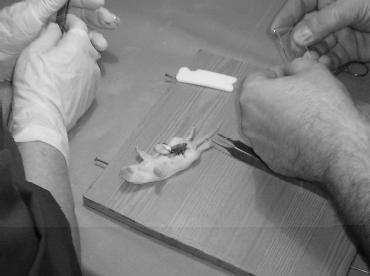
[IMAGE 3 — Pancreas tissue preparation from a newborn rat, mounted on a microscope slide for placement in the laser optical block]
[IMAGE 4 — Schematic of the helium-neon laser with automatic thermofrequency stabilization and optical block for mounting the biological donor preparation]
The pancreas and spleen were extracted from pre-anesthetized infant rats and placed on a microscope slide within the optical block positioned in front of the laser. Since the viability of the preparation does not exceed 8–10 minutes, each preparation was used for only 5 minutes of irradiation. During each session, organs from four infant rats were used, making the total irradiation time per organ per session 5 × 4 = 20 minutes. A total of 2 irradiation sessions were conducted.
Result: Blood glucose concentration in all rats stabilized within the range of 6–7.5 mmol/l. Not a single rat died.
All rats were sacrificed after 7 days for examination of internal organs.
[IMAGE 5 — Histological sections of rat pancreas: comparison between the control (deceased) group and the experimental group at 7 days post-experiment]
5. Holographic Control of Biosystems: Theory and Experiments
5.1 The Principle of Holographic Control
The term “holography” derives from the Greek holos (whole, complete) and graphia (image), denoting a full volumetric image of an object. The method of holography was first proposed by D. Gabor in 1948.
The principle of holographic control consists of passing laser or electromagnetic radiation through translucent biological cells of a donor, which modulate this radiation with their own polarization-phase hologram. To ensure stable and undistorted retention of the read information in the beam, a method of vibration-resistant polarization-dynamic transformation was developed, along with a sensor-converter device for its implementation. The physical basis of this converter is the principle of redundant coding of each amplitude-phase scattering object point in the form of polarization rings similar to Newton’s fringes.
5.2 Key Technical Achievements
Dynamic stability of polarization holograms. At any micro-movements of internal or external structures of the donor or recipient — or of the laser beam itself — the same system of polarization rings directed toward the recipient cells is maintained. This proved especially important when working with living biological organisms.
Transfer to a distant zone. Managing polarization-holographic information was successfully transferred from the donor to a distant zone where the recipient was located — a distance considerably exceeding the wavelength of the probing laser signal.
Preservation of genetic redundancy. In polarization-holographic coding and broadcast, redundancy is ensured such that even in the case of partial degradation of the managing rings corresponding to some point of the donor, the remaining rings are sufficient for correct reconstruction of the corresponding donor point.
Transfer of information from healthy cells to diseased ones. During near-resonance exposure of sufficient duration, the phenomenon of holographic control of recipient cell conditions was observed — the state of recipient cells improved, approaching the normal state characteristic of young, healthy donor cells.
5.3 Experimental Results on Biosystems
The method and device were repeatedly verified experimentally on plants, bacteria, and terminally ill animals in a coma state. In particular:
- Plant tyloses (cherry): the number of shoot formations in the holographic information transfer group was 26.1 ± 9.2% versus 3.6 ± 2% in the untreated control group
- Bacteria (Enterococcus hirae): 43% of vancomycin-resistant bacteria acquired sensitivity to vancomycin and died after laser irradiation with field structure from a sensitive donor strain
- Rats (WISTAR population): alloxan-induced diabetes mellitus was successfully treated — blood glucose stabilized and regeneration of pancreatic tissue was confirmed histologically
6. The Device and Method of Multiplex Laser Spectroscopy
A device and method for multiplex laser spectroscopy was developed by the research group and registered as Patent No. 2005104490 (publication date: 10.08.2006).
Authors of the patent: G.G. Tertyshny, A.G. Chuchalin, E.I. Maevsky, M.L. Uchitel, K. Khan
IPC Class: G01N21/63
The method is based on a two-mode helium-neon laser with automatic thermofrequency stabilization, which ensures equalization of radiant power in two combined, orthogonally polarized radiation modes. The optical block creates a standing wave system between semi-transparent mirrors, within which biological donor material is placed for modulation of the laser beam.
7. Discussion
The results of the experiments described in this article raise a number of important questions that remain the subject of ongoing investigation:
1. What is the nature of the biological information carrier? The experiments suggest that the relevant carrier is the low-frequency electromagnetic radiation produced by changes in cell membrane permeability, rather than mitogenetic UV radiation. This low-frequency radiation is capable of penetrating living tissue and is of sufficient power to modulate the laser-generated radio waves.
2. What is the mechanism of radio wave generation by the laser? The proposed hypothesis involves plasma striations spontaneously arising in the laser tube, which undergo amplitude modulation by biological signals from the donor tissue. The laser tube then functions as a radiating vibrator.
3. Is this information truly biological in nature? The control experiments are unambiguous: laser irradiation without a donor produced no measurable effect in either the bacterial or rat experiments. The effect was consistently observed only when the laser beam carried modulated information from healthy donor tissue.
4. What are the implications for regenerative medicine? The activation of pancreatic regeneration observed histologically in treated rats — without any pharmacological intervention — points to a fundamentally novel approach to stimulating tissue regeneration through information transfer rather than direct biochemical manipulation.
8. Conclusions
- The frequency-amplitude components of the electromagnetic field structure of bacteria can be non-invasively transferred between strains using a helium-neon laser scanner, causing measurable changes in antibiotic sensitivity in 43% of recipient bacteria (p < 0.001).
- Radio waves modulated by information from healthy pancreatic and splenic cells of newborn rats produced a significant therapeutic effect in rats with alloxan-induced diabetes mellitus — 80% survival in primary experiments, 100% survival with stabilized blood glucose in subsequent RSCS experiments, versus 100% mortality in untreated controls.
- The source of biologically active radiation responsible for the therapeutic effect is most likely the low-frequency electromagnetic radiation caused by changes in cell membrane permeability, not mitogenetic UV radiation.
- A hypothesis is proposed that plasma striations in the laser tube provide the mechanism for radio wave generation, with amplitude modulation by biological signals from donor tissue.
- Holographic polarization-dynamic methods allow stable, geometrically undistorted transfer of biological control information from donor to recipient over distances far exceeding the laser wavelength.
References
- Budagovsky A.V. Remote intercellular interaction. Moscow: NPLTS “Equipment”, 2004. 103 p.
- Garyaev P.P., et al. Influence of electromagnetic radiation modulated by biostructures on the course of alloxan diabetes mellitus in rats. Bulletin of Experimental Biology and Medicine. 2007, No. 2, pp. 155–158.
- Gurvich A. and L. Mitogenic radiation. Physical and chemical foundations and applications in biology and medicine. Moscow: Medgiz, 1945. 284 p.
- Denisyuk Yu.N. On the reflection of optical properties of an object in the wave front of the radiation scattered by it. Doklady AN USSR. 1962, vol. 144, No. 6, pp. 1275–1278.
- Kneppo P., Titomir L.I. Biomagnetic measurements. Moscow: Energoatomizdat, 1989. 287 p.
- Nedospasov A.V. Striations. Advances in Physical Sciences. 1968, vol. 94, issue 3, pp. 439–462.
- Plonsey R., Barr R. Bioelectricity: A Quantitative Approach. Moscow: Mir, 1992. 366 p.
- Tertyshny G.G., Garyaev P.P. Wave genetic nanotechnologies for biosystem management. Theory and experiments. New Medical Technologies / New Medical Equipment. 2007, No. 7, pp. 49–64.
- Sturrock P.A., Ball R.H., Baldwin D.E. Radiation at the Plasma Frequency and its Harmonic from a Turbulent Plasma. The Physics of Fluids. 1965, vol. 8, No. 8, p. 1509.
- Tertyshny G.G., Garyaev P.P., Roslov V.N. Method of analysis of physical objects and device for its implementation. International application priority No. 99/01/L of 06.01.1999.
- Prangishvili I.V., Tertyshny G.G., Garyaev P.P., et al. Genetic structures as a source and receiver of holographic information. Sensors and Systems. 2000, No. 2, pp. 2–8.
- Tertishniy G.G., Gariaev P.P., et al. The DNA-Wave Biocomputation. Consciousness and Physical Reality. Vol. 2, No. 2, 2000, pp. 26–33.
- Chuchalin A.G., Tertyshny G.G., et al. Device and method of multiplex laser spectroscopy. Patent No. 2005104490 of 21.02.2005.