
The Impact of Torsion Fields on Water and Plants
Based on: Shipov G.I. The Theory of Physical Vacuum. Part Six: “Experimental Manifestations of Torsion Fields”, Section 1. Academy of Trinitarianism, Moscow, 2003.
1. The Permanent Magnet as a Source of Static Torsion Field
One of the most accessible natural sources of a static torsion field is the permanent magnet. To understand why, it is necessary to consider the relationship between the mechanical rotation of electrons and the magnetic properties of magnetized matter.
The electron is a charged particle. Its intrinsic mechanical rotation — spin — creates a circular current, and this current generates a magnetic field that forms the magnetic moment of the electron. This connection between mechanical rotation and magnetic moment was formalized by American physicist S. Barnett in 1909. His reasoning was straightforward: if mechanical rotation of a charged body generates a magnetic field, then the collective alignment of electron spins within a ferromagnet should produce a measurable macroscopic magnetic field.
Barnett confirmed this experimentally. When a non-magnetized ferromagnetic rod is set into mechanical rotation, the electron spins — initially randomly oriented — begin to align along the axis of rotation. As the magnetic moments of individual electrons sum in a common direction, the ferromagnet becomes magnetized. The reverse experiment was successfully conducted by A. Einstein and W.J. de Haas in 1915: by changing the total magnetic moment of electrons in a ferromagnet, they caused the ferromagnet to begin rotating mechanically — directly demonstrating the equivalence of magnetic and mechanical angular momentum in magnetized matter.
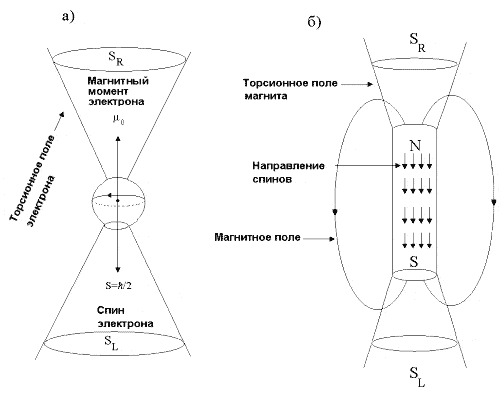
Since the mechanical rotation of an electron generates not only a magnetic field but also a torsion field, any permanent magnet is simultaneously a source of a static torsion field. The north and south poles of a magnet correspond to right-handed and left-handed torsion fields respectively.
[IMAGE 1 — Fig. 36. Torsion fields created by: (a) a single electron; (b) a permanent magnet — showing the spatial distribution of right-handed and left-handed torsion field components]
2. Torsion Effects on Water
Water is a dielectric. The magnetic field of a permanent magnet does not directly interact with it — dielectric materials are, by definition, unaffected by static magnetic fields. The torsion field, however, is a different matter.
When the north pole of a magnet is directed toward a glass of water — such that the right-handed torsion field acts upon it — the water gradually acquires a corresponding torsion charge and becomes, in torsion terms, right-handed. This state persists for a measurable period after the exposure ends.
The biological effects of such torsion-treated water have been studied experimentally:
- Plants watered with right-torsion-charged water show accelerated growth compared to control groups watered with untreated water.
- Seeds treated before sowing with the right-handed torsion field of a magnet demonstrate increased germination rates. This effect was sufficiently reproducible and significant to merit the filing of a patent.
The left-handed torsion field produces the opposite result: seeds treated with left-handed torsion radiation show reduced germination rates compared to the control group.
These findings establish a consistent directional asymmetry in biological response to torsion fields: right-handed static torsion fields exert a stimulating and beneficial effect on biological objects, while left-handed fields produce a suppressing or depressing effect.
3. Direct Torsion Radiation Experiments on Plants (1984–1985)
In 1984–1985, a series of experiments was conducted in Russia to study the effects of torsion generator radiation on the living tissues of various plant species, including cotton, lupine, wheat, and pepper.
3.1 Experimental Setup
The torsion generator was positioned at a distance of 5 meters from the plant under study. The radiation pattern of the generator was directed so as to encompass both the stem and the root system of the plant simultaneously. In all cases, the plants were exposed to a right-handed torsion field.
3.2 Measurement Method
The biological response of the plant tissues was assessed by measuring the relative dispersed conductivity (NDC) of plant tissues — specifically of the stem and root — across a frequency range from 1 to 512 kHz. This parameter reflects changes in the electrophysiological state of plant tissue and serves as a sensitive indicator of cellular response to external influences.
3.3 Results
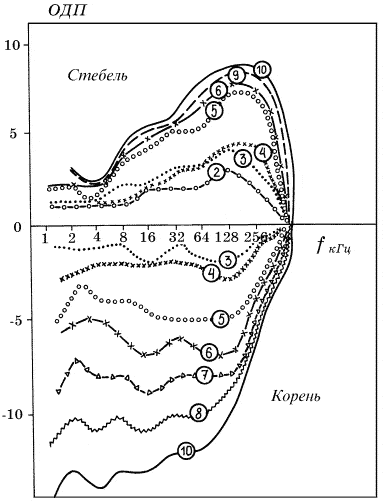
[IMAGE 2 — Fig. 37. Measurement results of the NDC of cotton in the frequency range 1–512 kHz. Time interval between curves: 2 minutes. Zero value of NDC corresponds to the absence of torsion radiation exposure.]
The results demonstrated clearly that torsion radiation produces measurable changes in the conductivity of plant tissues. Importantly, the response differed between the stem and the root system: the two tissue types exhibited distinct patterns of conductivity change under identical torsion field exposure.
Key observations:
- The onset of conductivity changes was detectable within minutes of the beginning of exposure, as shown by the successive measurement curves taken at two-minute intervals.
- The changes were consistent and reproducible across multiple trials.
- The directional asymmetry established in the water and seed experiments was consistent with these results: right-handed torsion field exposure produced responses characteristic of biological stimulation.
4. Discussion
The experimental results described above establish several important points regarding the interaction of torsion fields with biological systems:
Torsion fields act on water despite its dielectric nature. This confirms that torsion interaction is physically distinct from electromagnetic interaction and operates through a different mechanism — consistent with the theoretical understanding of the torsion field as a spin polarization state of the physical vacuum rather than an electromagnetic phenomenon.
The biological effects are directionally asymmetric. Right-handed and left-handed torsion fields produce qualitatively opposite effects on living systems — stimulation versus suppression of growth and germination. This asymmetry mirrors the fundamental chirality of biological molecules, most of which exist in only one of two possible mirror-image forms. The preference of living matter for right-handed torsion fields may be connected to the predominance of left-handed amino acids and right-handed sugars in all known life forms.
The effects are transmitted over significant distances. The 5-meter separation between the torsion generator and the plant in the conductivity experiments demonstrates that torsion field effects are not limited to direct contact or near-field interaction, but propagate through space in a manner analogous to other field phenomena.
Plant stem and root tissues respond differently to the same torsion field. This differential response suggests that torsion field sensitivity is tissue-specific and may reflect differences in cellular organization, water content, and the orientation of biomolecular structures within different tissue types.
Conclusion
The experiments summarized here provide consistent and reproducible evidence for the action of static and dynamic torsion fields on biological systems — specifically on water, seeds, and plant tissues. The effects are directionally dependent, distance-independent over ranges of several meters, and measurable through standard electrophysiological methods.
These findings contribute to a growing body of experimental evidence suggesting that the torsion field — understood as a spin polarization state of the physical vacuum — represents a physically real and biologically significant form of interaction that is not reducible to known electromagnetic, gravitational, or acoustic mechanisms.
Reference
Shipov G.I. The Theory of Physical Vacuum. Part Six: “Experimental Manifestations of Torsion Fields”, Section 1. Academy of Trinitarianism, Moscow. Electronic publication No. 77-6567, publ. 10795, 05.11.2003.